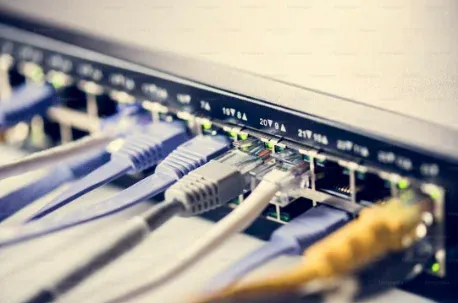
Cameras, gate operators and access controllers all depend on one thing: the cable, the switch and the power behind them. We build that layer so the rest of the system keeps working when the weather, the utility or the ISP does not.

Nobody buys a network. They buy cameras that record, a gate that opens from a phone, and a log they can pull — all of which stop the moment the layer underneath them does. Most of the "camera problems" and "gate problems" we are called out to are network problems: a flooded conduit, an unpowered switch in a hot cabinet, a consumer router asked to carry eight video streams.
So we build it as infrastructure. Runs are certified and documented, not just terminated. Security devices sit on their own segment, so a camera cannot reach your office network and a fault is easy to isolate. Switches, recorders and controllers sit on battery. And where copper cannot reach — a gate 400 feet down a drive, a building across a yard — we get there on fiber or a licensed wireless link rather than hoping.
On its own this layer is invisible. Under a gate, a fence carrying conduit, access control writing logs and cameras recording, it is the reason all four are still working next year — which is the Complete Security Gate System.
We build on commercial-grade brands — Ubiquiti UniFi, Araknis, Cisco Meraki, APC — and untangle consumer gear another installer left behind. See the brands we work with.
Two things decide whether a security network holds: how you cross distance outdoors, and what stays up when power or the ISP goes away. We size both deliberately — media chosen for the run, PoE budget calculated rather than assumed, battery on everything the system cannot lose, and cellular failover where remote access matters.
We cable new sites, repair and certify existing runs, and clean up wiring left by whoever came before — usually with a documented rack at the end of it.
Certified, labeled and documented runs — not a bundle of untested cable.
Past 100 meters, copper stops. Fiber in conduit, or a licensed-band bridge.
Power budget calculated for every camera, reader and operator on the switch.
Security devices on their own segment, isolated from the office network.
Recording and gate cycles survive an outage; cellular covers a dead ISP.
Cameras dark, gate unreachable, no remote access — we dispatch across SoCal.
CALL 661-605-3266 →Which method fits comes down to distance, whether you can trench, and how much the link is carrying.
Cat6 in conduit, certified and labeled. Carries data and PoE power on one run up to 100 meters.
For long drives and separate buildings. Immune to distance limits, lightning and electrical noise.
Where trenching is impossible or absurd. Line-of-sight link across a yard, a road or a canyon.
Managed switches, surge protection and a rack you can actually work in, with labels that match the drawing.
Coverage across yards, gates and outbuildings for tablets, phones and mobile credentials.
Cable already in the ground and nobody knows what it goes to. We test and certify what is there before quoting new runs.
HAVE US TEST YOUR RUNS →Every device that needs a link, how far it is, and what power and conduit already exist.
Copper, fiber or wireless per run, PoE budget, segmentation and battery — on a drawing.
Runs pulled, terminated, certified and labeled; switches configured and documented.
You get the as-built drawing and labels that match it — and we watch for the link that starts failing.
Hardware is the small line here; labor and distance are the big ones. These are the five things that move a network quote, in the order they usually matter.
Based in Santa Clarita, cabling and servicing across Los Angeles, Ventura and Kern counties.
Cameras, operators and controllers all share the same wire, and they compete with everything else on site. Their own segment keeps recording steady, stops a compromised device reaching your office network, and makes a fault easy to isolate.
Copper is reliable to about 100 meters. Past that we run fiber in conduit where trenching is possible, or a licensed-band wireless bridge where it isn't — with power and a weather-rated enclosure at that end.
Switch, recorder and controller go on UPS and battery, so the system keeps recording and the gate keeps cycling through a typical outage. Where losing remote access matters, we add cellular failover.
Often — and we test before condemning it. We certify each existing run, reuse what passes and replace what doesn't, which is usually cheaper than re-pulling a whole site.
The free estimate prices the work you already want. The paid assessment is a Red Team walk of your perimeter, with a written report.
We protect people, property, and peace.